
Measure the opening
Height and width of the clear area you see through, in millimetres. Take each in three places and keep the smallest.
MagicSeal · Measure and fit guide
Most windows take three steps: measure the opening, check the frame around it, add 26 mm. The rest of this guide covers the windows that need more, including a window behind a ranch slider.
The short version
Height and width of the clear area you see through, in millimetres. Take each in three places and keep the smallest.
Each side needs 14 mm or more of flat frame for the magnetic tape to stick to.
Add 26 mm to the height and 26 mm to the width. That is the size you order.
Step 01
A magnetic screen is a little bigger than the window opening. It overlaps the flat frame around the opening and holds there on magnetic tape. So you measure the opening, then add the overlap.
Size to order = opening + 26 mm each way
That is 13 mm of overlap on each side. An opening 1,200 mm high and 900 mm wide needs a screen 1,226 × 926 mm.
Size helper
Enter your smallest height and width. If every side has 14 mm or more of flat face, that is all you need. Change a side only if it is narrow or has no flat face.
If your three readings differ by more than a few millimetres, the opening is out of square. Send us the readings and a straight-on photo before you order.
You will see the opening called the daylight opening on some of our pages. It is the same thing.
Step 02
Work out each side on its own. A side that is fine still gets its 13 mm.
Add the face width, less 1 mm
An opening 500 mm wide with 12 mm of flat face on both sides gets 11 mm a side: 522 mm wide. If only one side were narrow, the other would still get 13 mm: 524 mm.
The tape needs at least 9 mm stuck to the frame to hold. If a side has less than 10 mm of flat face, send us a photo before ordering. A little tape overlapping the glass can be fine; too little on the frame is not.
Some windows have a side with nothing flat to stick the tape to. It is usually where the window runs straight into a wall or into the frame of a sliding door. A 15 mm plastic angle goes on that side first, and gives the tape a face.
For this window the width to order is A, take off 2 mm for the angle side, add 13 mm for the flat-face side.
Measure to the surface the angle sticks to, then take off 2 mm
Do not add 13 mm on an angle side. The angle sits about 2 mm into the opening, so the screen is 2 mm smaller on that side.
One angle side: from the wall on the left to the inside edge of the flat face on the right is 900 mm. Take off 2 mm for the angle side and add 13 mm for the flat-face side. Order 911 mm wide.
An angle on both sides: wall to wall is 900 mm. Take off 2 mm twice. Order 896 mm wide.
You do not need the angle in your hand to measure. Measure to the wall or frame it will stick to and the sum above does the rest.
Add the angle when you order. There is a tick box for it when you configure your screen. A length is 2.4 m of angle with tape already on it, supplied as four 600 mm pieces so it travels with the screen. One length does one side of any screen, or two sides that add up to 2.4 m or less.
Step 03
A magnetic screen usually fits on the window a ranch slider slides across. There are two things to check.
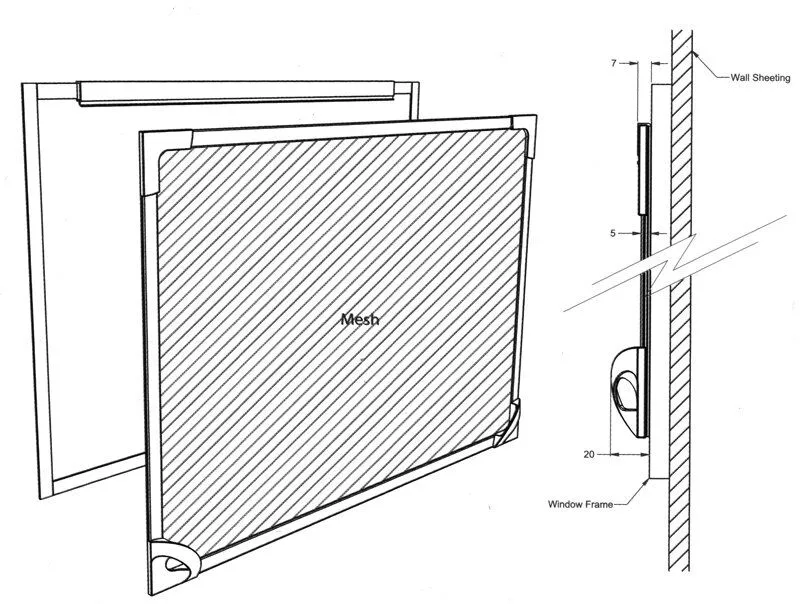
Slide the door across in front of the window. Measure from the face the screen will sit on to the back of the door.
The screen needs about 8 mm at the top and about 22 mm at the two bottom corners, where the corner pieces are deeper.
Do not rule it out. Send us the gap and some photos and we will tell you whether it will work before you order.
A window behind a ranch slider nearly always has at least one side with no flat face, where it meets the wall or the door frame. That side needs a plastic angle, and the angle changes the size you order.
Send one photo of the whole window from straight on, a close-up of each side, and one with the door slid across. Add your measurements and we will confirm the sizes with you.
The top edge may tuck into a drip tray if the screen can still be lifted out. Avoid trapping the sides and bottom. Small sections of frame tape can be cut out where a latch closes and where the supplied top clips sit.
Step 04
Step 05
With a clean lint-free cloth, for the final wipe of every face.
For neat tape gaps around latches and the supplied top clips.
The tape arrives aligned to the screen. Flipping or reversing a strip changes the polarity and can make the screen sit skewed or hold poorly.
Step 06
Lift the screen away using the pull point. Use a soft cloth or soft brush on the frame and mesh.
Hose the screen outside if needed, then let it dry completely before refitting.
Check that no magnetic strip was flipped, reversed or moved out of its supplied order.
Remove contamination, let the surface dry, and press firmly. Use the enquiry form if the substrate or adhesive has failed.